


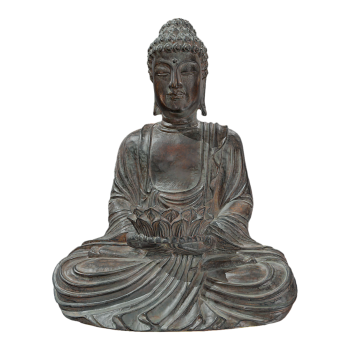
The sitting statue of Shakyamuni Buddha during the Guishuang Empire period
The Kushan Empire was an ancient prosperous country that existed in Central and South Asia. During its peak period (105-250 AD), its territory extended from present-day Tajikistan to the Caspian Sea, Afghanistan, and the Ganges River basin. Guishuang is a branch of the Dayue people who lived in the Amu Darya and Syr Darya river basins in the 2nd century BC. In 130 BC, the Yue people migrated south to conquer Daxia and divided it into five tribes, each with a chief called the Marquis of Xi. The Guishuang Xiahou Qiu, one of the Five Xiahou, eliminated the other Xiahou, unified the five tribes, and established the Guishuang Kingdom. However, Qiu defeated Anxi and attacked the Kabul River Basin and Kashmir region southward, eventually establishing the capital as Gaofu.

Sitting Statues of Sakyamuni Buddha in the Period of the Imperial Empire of Gui Shuang
The statue depicts the image of Buddha Sakyamuni in a state of enlightenment, sitting in a meditative posture. This statue is probably an early Buddha found by the site of Jamal Garry in the ancient Gandhara region of modern Pakistan during the Kisam Empire, during the 2-3rd century AD.

Popular Models


Honey Badger (3D animated model)
194 View

Guinea fowl (3D animated model)
165 View

Wild Goose (3D animated model)
187 View

Red Fox (3D animated model)
155 View
Random Model



Green Small Backpack
888 View

Fried Chicken
975 View

Smena-6 camera (1961)
816 View

Gulf Toad Fish Specimen
568 View

Microlab Solo 5c Speakers
663 View